Harold Edward HOLT

Summary
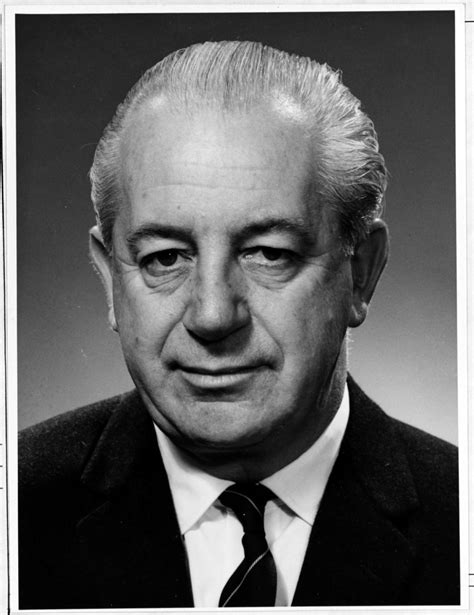
Biography
Harold Edward Holt (5 August 1908 – c. 17 December 1967) was an Australian politician who served as the 17th prime minister of Australia from 1966 until his disappearance and presumed death in 1967. He held office as leader of the Liberal Party of Australia and held various ministerial positions from 1949 to 1966 in the governments of Robert Menzies and Arthur Fadden.
Holt was born in Sydney and moved to Melbourne in childhood, studying law at the University of Melbourne. Before entering politics, he practised law and was a lobbyist for cinema operators. He was first elected to the House of Representatives at the 1935 Fawkner by-election, aged 27, as a member of the United Australia Party (UAP). Holt was made a minister without portfolio in 1939, when his mentor Robert Menzies became prime minister. His tenure in the ministry was interrupted by a brief stint in the Australian Army, which ended when he was recalled to cabinet following the deaths of three ministers in the 1940 Canberra air disaster. The government was defeated in 1941, sending the UAP into opposition, and he joined the new Liberal Party upon its creation in 1945.
When the Liberals came to office in 1949, Holt became a senior figure in the new government. As Minister for Immigration (1949–1956), he expanded the post-war immigration scheme and relaxed the White Australia policy for the first time. He was also influential as Minister for Labour and National Service (1949–1958), where he handled several industrial relations disputes. Holt was elected deputy leader of the Liberal Party in 1956, and after the 1958 election replaced Arthur Fadden as Treasurer. He oversaw the creation of the Reserve Bank of Australia and the decimal Australian dollar, but he was blamed for a credit crunch that almost cost the Coalition the 1961 election. However, the economy soon rebounded, and Holt retained his place as Menzies' heir apparent.
Holt became prime minister in January 1966, elected unopposed as Liberal leader following Menzies' retirement. He fought a general election later that year, winning a landslide victory. The Holt government continued the dismantling of the White Australia policy, amended the constitution to give the federal government responsibility for indigenous affairs, and took Australia out of the sterling area. Holt promoted greater engagement with Asia and the Pacific, and made visits to a number of East Asian countries. His government expanded Australia's involvement in the Vietnam War, and maintained close ties with the United States under President Lyndon B. Johnson. While visiting the White House, Holt proclaimed that he was "all the way with LBJ", a remark which was poorly received at home.
In December 1967, Holt disappeared while swimming in rough conditions at Cheviot Beach, Victoria. He was presumed dead, although his body was never recovered; his disappearance spawned a number of conspiracy theories. Holt was the third Australian prime minister to die in office. He was succeeded by Country Party leader John McEwen on an interim basis and then by John Gorton. His death was commemorated in a number of ways, among them by the establishment of the Harold Holt Memorial Swimming Centre in Melbourne, and the Harold E. Holt Naval Communication Station in Exmouth, Western Australia.
Profile
Harry
,Mr Holt
Ministerial Career (Before Becoming PM)
Minister for Immigration (1949–1956)
- Oversaw expansion of Australia’s post‑war immigration program.
- Supported the “populate or perish” strategy to grow Australia’s workforce and defence capacity.
- Continued dismantling elements of the White Australia Policy, including allowing non‑European war refugees to remain.
Minister for Labour and National Service (1949–1958)
- Managed industrial relations during a period of major union activity.
- Oversaw national service (conscription) programs during the Cold War.
- Played a key role in stabilising post‑war labour markets.
Treasurer of Australia (1958–1966)
This was Holt’s most influential pre‑PM role.
Key achievements:
- Introduced decimal currency (1966), replacing pounds, shillings, and pence with dollars and cents.
- Oversaw strong economic growth during the long Menzies era.
- Managed Australia’s financial transition into a modernised global economy.
- Strengthened ties with international financial institutions and trade partners.
Prime Minister of Australia (1966–1967)
Foreign Policy & Defence
- Deepened Australia’s involvement in the Vietnam War, increasing troop commitments.
- Strengthened Australia’s alliance with the United States, famously declaring: “All the way with LBJ.”
- Supported the establishment of Pine Gap, a major US–Australia intelligence facility.
- Oversaw expansion of conscription (National Service Scheme) for Vietnam.
Domestic Policy
- Continued gradual dismantling of the White Australia Policy, allowing increased non‑European migration.
- Supported Indigenous policy reforms, including early steps toward the 1967 referendum (completed under Gorton).
- Oversaw major economic expansion and infrastructure development.
- Advanced social policy modernisation, including early discussions on divorce law reform and welfare improvements.
International Relations
- Strengthened ties with Southeast Asian nations through early regional diplomacy.
- Supported Australia’s participation in the Asia-Pacific Economic Cooperation precursors.
- Advocated for closer Commonwealth cooperation.
Political Style & Leadership
- Known for a modern, media-friendly leadership style, contrasting with Menzies’ more traditional approach.
- Promoted a more outward-looking, internationally engaged Australia.
- Encouraged a generational shift in the Liberal Party.
Notable Events
- 1966 Federal Election: Won in a landslide, securing one of the largest Liberal Party victories in Australian history.
- 1967 Disappearance: Vanished while swimming at Cheviot Beach, Victoria.
- His death ended his prime ministership abruptly and remains one of Australia’s most famous political mysteries.
Legacy
- Decimal currency remains one of Australia’s most significant economic reforms.
- His Vietnam War decisions shaped Australian foreign policy for decades.
- His immigration reforms helped dismantle racial exclusion and diversify Australia’s population.
- His disappearance created enduring public fascination and historical debate.
Occupations
Employed as a Lawyer
- Best Hooper Lawyers Employed by
Events
Harold Holt Disappears
Disappeared at Cheviotte Beach, Victoria in 1967, Presumed to have drowned. His body was never found
- Alan Stewart Witness
- Marjorie Gillespie Witness
Memberships
Joined the Liberal Party
- United Australia Party Successor to — 1945
- Liberal Party of Australia Subject
Organisations
Queens College
Lived at Queens College while on a scholarship at the university of Melbourne
- Harold Holt Subject — 1927
Claims
Harold Holt was a Spy for Communist China
- Anthony Grey Author — 1983
- Harold Holt Subject
Documents
The Prime Minister was a Spy
- Anthony Grey Author — 1983